



September 15, 2010
In the wake of the DE primary election, Karl Rove came out blasting O'Donnell. For some reason, this surprised and infuriated a lot of people. These folks need to step back and rethink their previous adulation of Rove.
Karl Rove is an election tactician. Period. He's not a conservative. He's not a long-term strategist. He's only a Republican by whatever accident of fate put him in the party. He'd be just as comfortable doing his thing for the Dems, as he has zero ideological basis to his actions.
To him, nominating O'Donnell over Castle is the height of stupidity, as you go from a likely win to a likely loss. The concept that, if the Republican is going to vote like a Dem, it would be better to have a Dem in the seat, is completely foreign to him. The idea that ideology matters simply does not compute in Rove's brain.
And all this is fine, if Rove has bosses that take ideology and strategy into consideration, and keep their pet tactician on an extremely short leash. The problem is, as the GOP 'leadership' has become about maintaining their personal power and political perks at all costs, Rove has become the defacto face of the GOP establishment.
As can be seen from the time Rove came to prominence, having him as a party leader has been a complete disaster. Sure, he won a few tight elections -- there's no doubt he is an excellent tactician. However, the cost to win those elections in terms of sacrifice of principle and sound governance has proven to be far too high. This is why there is a huge rebellion against the GOP establishment. In the attempt to keep any power they can, the GOP leaders have triangulated themselves into oblivion, and now stand for precisely nothing.
It would be nice if someone in a GOP leadership position would take Rove aside and tell him that he'll be called upon when needed to manage a tight election with a desirable candidate, but otherwise he can piss off. This won't happen, of course, as Rove is far too full of himself at this point, and the GOP leadership simply isn't that smart.
So, all this fury at Rove for, well, being Karl Rove, is a bit perplexing. He'll end up being marginalized, which is what should have happened to him ages ago. When your pet tactician goes rabid and gets off his leash, the best thing to do is put him down.
Posted by: Hermit Dave at
11:43 AM
| Comments (1)
| Add Comment
Post contains 423 words, total size 3 kb.
August 02, 2010
Sinead O'Connor. I mean, besides exploding her career on national TV. Come to think of it, it might be best not to know. Even so, her voice can still send a chill up my spine, especially on this, the best of her songs:
I should be sick of this song as a bar buddy of mine used to get drunk and play it on the juke over and over after her girlfriend broke up with her. I still love it though.
Posted by: Hermit Dave at
03:09 PM
| No Comments
| Add Comment
Post contains 85 words, total size 1 kb.
July 31, 2010
As complex as things are in the financial world, it helps to return to first principles from time to time. The key principle in economics is the notion of wealth.  That $20 in your pocket (or 62 cents and a broken rubber band for most morons) is a representation of wealth in an economy that's complex enough to require a medium of exchange, but it's not wealth in and of itself. It's a piece of very fancy paper. So, what is wealth and where does it come from?
All wealth originates from the exploitation of natural resources. Without food, clothing, shelter, and energy, your new iGadget isn't going to do you much good. From there, almost all remaining wealth is created from two areas: Increases in productivity, and services provided to improve living standards. Lastly, there is the preservation of wealth, as there isn't much point in gaining wealth if someone bigger and meaner than you can come along and just take your wealth away, or if your wealth-gaining efforts despoil the natural resources to an extent that future wealth can no longer be created.
It helps to imagine a small farming community, where everyone does everything for themselves. Pa Kettle grows food, Junior Kettle hunts game and Ma Kettle sews clothes from the pelts of animals Junior brings home to the house they built themselves. Suddenly Pa gets an amazing idea -- he'll use his mule to increase the amount of food he can grow and harvest. Now Pa can grow enough food to feed 5 families. This lets one of his neighbors grow cotton instead of food and supply better clothes to the Kettles in exchange for food. Meanwhile, the lousy, but very imaginative, farmer down the way can stop subsisting on his own farming and instead tell everyone else entertaining stories in exchange for food and clothing. Finally, the other two farmers beat their plowshares into swords to protect this small community from the hippie commune over the next hill. Thus a basic barter economy is born.
Fast forward to today and ask yourself: Why are we, as a society, wealthy? Who provides this wealth? If we do A instead of B will this wealth increase or decrease? The 'science' of economics is supposed to provide answers to these key questions within the context of a complex economy. Unfortunately, most of modern economics is consumed with esoterica that does nothing to address these very basic concepts.
For example, how should one view the Government within this basic economic framework? The standard libertarian answer is that the sole function of Government is to preserve wealth, thus Government should be limited to self-defense, dispute adjudication, and a few other very basic functions. A libertarian believes that, due to the selfish nature of mankind, the Government can only be a rent-seeker (a person or entity that derives its existence from a continuing claim on the wealth of others), thus Government should be as small as possible. Those who advocate socialism would claim (whether or not they realize it) that the Government can somehow be a primary provider of societal wealth (good luck trying to demonstrate that). A 'conservative libertarian' such as myself is willing to admit that, in a large enough society, the Government can actually contribute to wealth in a limited form (productivity increases from the interstate highway system being my favorite example), and would allow for a few additional Government functions.
The point of this piece is not to try to analyze the true state of current economic conditions through first principles -- that would take several books, not a blog post from a moron. The point is to get the reader (all zero of you) to think about economics from a more basic perspective, so that it is much harder for someone to 'baffle you with bullshit'. Also, in the event of partial societal collapse (not impossible given the current state of the world) to consider how one might provide wealth in a more basic economy, thus ensuring personal survival.
The next time you're faced with trying to evaluate a complex economic question, simply ask yourself 'Does this idea create or preserve wealth?' It's amazing how easy it can be to cut through huge swaths of bullshit with this very basic question.
Posted by: Hermit Dave at
02:51 PM
| No Comments
| Add Comment
Post contains 720 words, total size 4 kb.
May 17, 2009
A) Easier than writing a coherent post on a serious topic
B) Far less depressing than reading the news
C) A bad idea, considering my taste in music
D) All that and a bag of chips
The The, Uncertain Smile:
Posted by: Hermit Dave at
07:38 PM
| No Comments
| Add Comment
Post contains 44 words, total size 1 kb.
May 15, 2009
Continuing the chill out / fiddle while Rome burns idea, here's another great video. Â It's The KLF with a very special (and completely unexpected) guest vocalist, doing a remix from their brilliant album The White Room.
Posted by: Hermit Dave at
10:17 PM
| No Comments
| Add Comment
Post contains 41 words, total size 1 kb.
The economic news today is even more disgusting than yesterday. Â No, I really don't care about the political infighting ... if you want to fiddle while Rome burns, have at it.
All right, I too want to fiddle while Rome burns, but at least I'll be honest about it. Â I've actually been reviewing Youtube vids for the last 6 hours or so, trying to come up with some ideal combination of my favorite music with videos that reflect why I really like that music.
This is way way harder than it sounds.  Anyway, after hours of review, here's Massive Attack, Teardrop:
Posted by: Hermit Dave at
01:50 AM
| No Comments
| Add Comment
Post contains 104 words, total size 1 kb.
May 14, 2009
There's just not enough humor potential to keep this topic going. Â I'm still not smoking, I'm doing reasonably well on reducing my NRT over the 3-month course, and my recovery is painful, but on track.
I may start a new topic (something along the lines of Health and Fitness) about overcoming bad habits and health issues, but this topic is dead in the water. Â If I faill massively and start smoking again, I'll be honest about it, but I sincerely think that I'm finally done with this terrible addiction.
Posted by: Hermit Dave at
12:01 AM
| No Comments
| Add Comment
Post contains 96 words, total size 1 kb.
May 13, 2009
I haven't been posting much over the last few weeks because, aside from slowly recovering from massive nicotine withdrawl, I've been too busy reading all the back history at FMyLife catching up on FEM (Finance, Economics, and Markets). I knew things were really bad, and have said for a while now that Paulson and Bernacke (and Geithner since the Administration change) are completely corrupt, and robbing us blind. Unfortunately, as cynical and pessimistic as I am, it's far worse than I had thought.
Now that I'm up to speed, and not completely delerious from lack of nicotine, I'll hopefully have some thoughts about what one can do financially going forward. In the meantime, please continue to educate yourself, and try to encourage others to do the same. The future of the USA depends on the average voter becoming much more informed on FEM and putting a halt to the partisan politics that is destroying the country.
While I'm organizing my thoughts, have a look at this post at Zero Hedge, and this one at The Market Ticker, for an indication of just how fucked up our government is. Then, watch this video at CSPAN of the most recent AIG hearings. Yes, I know it's almost four hours long. However, this kind of thing is so important, that you should try to make the time, even if it takes watching it in 30 minute stretches over the course of a week.
The choice is clear. We can either continue to look aside while the political/banking kleptocracy loots America until there's nothing left, or we can start taking action. Taking effective action requires knowledge. If you're not willing to turn off the fucking TV and educate yourself, then you're part of the problem, not the solution.
Posted by: Hermit Dave at
09:00 PM
| No Comments
| Add Comment
Post contains 298 words, total size 2 kb.
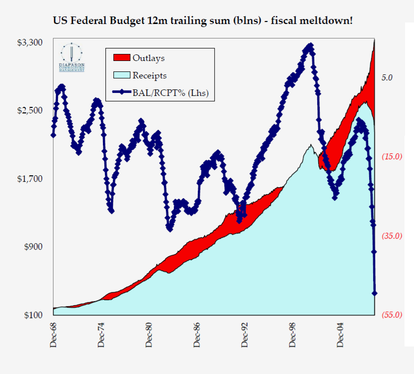
I think this chart speaks for itself, so I'll just be over here in the corner of my cave, whimpering like Obama without a teleprompter. (If you need some explanation, hit the link).
Posted by: Hermit Dave at
06:07 PM
| No Comments
| Add Comment
Post contains 42 words, total size 1 kb.
The Ho Index is a little known (only to me I think) but highly accurate economic indicator. It's the average price charged for one hour of regular services by a hooker in Las Vegas. Unfortunately it's usually a trailing economic indicator as Hos are slow to lower their prices during a downturn, so it's hard to make money as you can't use it as a market timer, and you can't go short Hos.
Anyway, Craigslist has announced that they're getting rid of their erotic services section. While this won't do a damn thing to the overall level of Ho activity, it will make it a lot harder to measure the Ho Index. Don't you State AGs have anything better to do than pressure CL to drop this section? Like, oh I don't know, start prosecuting people for the years of massive fraud in the real estate and financial markets? Useless bastards.
Posted by: Hermit Dave at
05:24 PM
| No Comments
| Add Comment
Post contains 160 words, total size 1 kb.
May 07, 2009
This article in the Independent provides a fascinating and troubling look into Dubai.
I've never been to Dubai, but having been an expat myself at one point, I feel qualified to comment on the typical attitude of wealthy western expats towards the working poor. This article, though extreme, is completely accurate from my experience. I found that the British were always the worst (in terms of their disdain for and abuse of the 'slave class'), followed by the continental Europeans, then the Americans. The Aussies were by far the best.
Dubai will most likely collapse, as it's a testament to the huge (and unsustainable) transfers of wealth from the world's working classes to its elite classes over the past 20 years. The only way in which it might survive is as a safe haven for the international kleptocrats, in the event that they are run out of their own countires due to a populace that is fed up with being robbed.
Posted by: Hermit Dave at
10:18 PM
| Comments (2)
| Add Comment
Post contains 166 words, total size 1 kb.
May 05, 2009
I'm getting better ...
Posted by: Hermit Dave at
09:16 PM
| No Comments
| Add Comment
Post contains 11 words, total size 1 kb.
May 01, 2009
As a follow-up to the prior post, I have a simple question for those who are against allowing mortgage cram-downs during bankruptcy:
Do you approve of TARP, TALF, and the various other backstops that protect the bondholders of insolvent banks at the expense of the taxpayer?
I believe the standard conservative answer would be a resounding "Hell, no."
So, please stop and think for a minute, because these two positions are incompatible. Â We have a huge amount of excess debt in the system, debt that is worth far far less than par based on today's asset prices and ability to service that debt. Â This debt is going to be unwound, one way or another. Â And no matter which way we do it, it won't be pretty.
In my opinion, we must minimize moral hazard, and keep taxpayer expenses to a minimum. Â All the various government programs so far, uinder Paulson and continuing under Geithner, have backstopped the management and bondholders on Wall Street at the expense of the taxpayer. Â I think most conservatives would agree.
How is an opposition to mortgage cram-downs any different? Â Fine, you can force Joe Blow into foreclosure and he'll lose his house, if that makes you feel better. Â However, instead of bothering to file for bankruptcy, he'll just mail in the keys (which is his right under a non-recourse loan), leave no forwarding address and change his phone number to try to dodge the credit-card collection system, and work to rebuild his life from scratch.
Meanwhile, the bank now has the same overpriced asset on their books that they can't write down for fear of their own bankruptcy, and because they're still too big to fail, the next round of government support will simply take more money out of the taxpayer to keep the zombie bank running.
There are plenty of other long-term consequences from this course of action, but I think I've made my point. Â Put aside partisanship and emotion, think through the broader economic consequences, and realize that the source of an idea isn't what's important, it's the idea itself.
One final note: Â Never, ever, ever, ever, ever read the comments to an economic post on a political website. Â You'll be both much dumber and much more aggravated than you would otherwise be, if you had just thought the issue through yourself. Â I've known this for ages, but damn, that seems to be one of those lessons I have to relearn twice a year.
Posted by: Hermit Dave at
07:48 PM
| No Comments
| Add Comment
Post contains 417 words, total size 3 kb.
Yesterday, the Senate defeated an amendment that would have allowed judges to change terms on mortgages during bankruptcy proceedings. This is being touted as a good thing by conservatives, but is it? Let's put aside partisan politics and take a close look at the situation.
The primary conservative argument is that of contract law. Â As Morrissey says at Hot Air:
That is the bigger principle at stake. We are supposed to be a nation of laws, and contract law is supposed to be binding. No one signs a mortgage with a gun at their head. Durbin and his allies want to end the notion that contracts mean what they say. Instead of binding agreements on which people can rely, contracts will become much like the Constitution for the Left — meaning whatever seems expedient from moment to moment.
Removing the political context, I agree with the substance of this. Â In the normal course of business, one must not be allowed to break contracts willy-nilly. Â However, bankruptcy is not the normal course of business. Â Bankruptcy is a very special case, where one's liabilities exceed one's assets, with insufficient cash flow to service debt. Â Personal bankruptcies can be due to bad luck, illness, financial mismanagement, or a host of other things. Â In the case of financial mismanagement, quite often the lender will be complicit in the bankruptcy, through the extension of imprudent credit.
A bankruptcy can be very difficult to sort out, with competing claims by creditors against assets that can be difficult to value. Â This is why we have bankruptcy courts. Â So, let's assume a simple case: Â Joe Blow bought a house for $500,000 by taking out a fixed-rate non-recourse secured loan for $400,000, with a 2nd to finance his down-payment. Â His house is now worth only $300,000, he has no savings, and $20,000 in additional credit card debt. Â The poor guy also lost his job and his dog ran away (just to give it that country music flavor). Â The simple facts of the case: Â He has debts of $520,000 against assets of $300,000 (assuming for simplicity his posessions are worth almost nothing), and no way to service his debt. Â Joe Blow is tapped out and headed for bankruptcy court.
What are the possible outcomes?
- Typically, the court will agree to let the bank foreclose on the house, leaving the bank with a physical asset instead of the $400k loan and a 2nd worth zero. Â The credit card company gets stiffed.
- Alternatively, the court could order a liquidation of the assets and pay creditors according to the seniority of the debt. Â So, the house sells (eventually, maybe) for $300k of which the bank gets everything (the $400k secured loan is primary), the 2nd is written off, and the credit card company of course gets stiffed. Â Given the typical mortgage contract, this will almost never happen.
- Under a cram-down rule, the judge could simply order that the house is now worth $300k and that the bank's $400k loan is now worth $0.75 on the dollar (note that this happens in corporate bankruptcies all the time). Â Now the bank has a decision to make. Â Assuming Joe still has no way to service debt, the end result is going to be the same as (1) above. Â However, perhaps Joe has gotten a new job in the meantime, and it's a job that would allow him to service the debt on a $300k loan, plus make payments against a lowered 2nd and even some payments against a lowered credit-card debt. Â Joe gets to keep his house, his dog comes back, and while he'll need to rebuild his credit rating, this would seem to be the best deal for everyone.
So, from a practical standpoint, we can see that, at worst, the cram-down won't make any difference, and at best might help everyone involved. Â Ahh, but we don't live in a practical world, do we? Â Why are banks so opposed to a cram-down rule for mortgages when the same type of thing happens in corporate bankruptcies all the time?
The answer is simple: Â In case (1) above, the bank has an asset against the original $400k loan, that it can still keep on the books at or near that level. Â Eventually, of course, it will have to dispose of this asset, but it allows the bank to decide when to take the write-down (if needed) or perhaps hold on to the asset in hopes of appreciation (which the bank now gets rather than Joe). Â Of course, the bank has to eat any further losses, but they were on the hook for that regardless.
In cases (2) and (3) above, the bank has to realize a loss immediately, and even though (3) would improve their cash-flow position going forward (and let the credit card company participate), they won't want to take that loss. Â Why? Â Becase the bank is also tapped out and can't afford the hit to capital. Â So, in the interests of continuing the sham of major bank solvency, a less-than-optimal overall economic result occurs.
I understand the emotional desire to punish those who leveraged their lifestyle and took out loans they couldn't afford.  I've been resposible, have zero debt, and am paying for this whole fiasco as much as anyone.  However, I find the arguments against cramdown in bankruptcy to be naieve.  At the end of the day, not allowing for mortgage cram-downs in personal bankruptcy merely prolongs the agony of the big banks, and protects them (and their bondholders) from their bad decisions, against broader societal (taxpayer) interest.
This will probably be the one and only time I agree with Dick Durbin, but the cram-down amendment should have passed.
Posted by: Hermit Dave at
02:02 PM
| No Comments
| Add Comment
Post contains 949 words, total size 6 kb.
April 30, 2009
Via Zero Hedge again, here is a chart comparing the broad financial position of the US at the start of the huge bull run in 1982 vs. now:
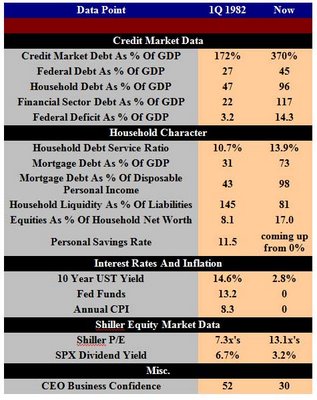
Just point this chart out to anyone who tries to tell you that we're turning the corner, that the market has bottomed, etc. Â As the government has refused to take the hard road by forcing bankruptcies in order to get the excessive debt out of the system, we're in for a long hard slog (whether that be 1970s style or 1990s Japan style) at best. Â At worst, the bumbling by the administration and the Fed will severely exacerbate the problem, although it may kick the can down the road a bit.
We're in completely uncharted territory here, as the financial and government oligarchy are attempting to respike the punch bowl while the markets still have alchohol poisoning. Â The stock market is trying to get drunk again, but I don't think it will work. Â More likely, it will start projectile vomiting and end up in the hospital, getting its stomach pumped, followed by a long stint in rehab.
Posted by: Hermit Dave at
08:21 PM
| No Comments
| Add Comment
Post contains 190 words, total size 1 kb.
April 29, 2009
Ok, let's imagine that this actually comes to pass, and the government installs GPS devices in all our cars. Think of all the fun you could have:
- Steal your neighbor's car and park it a few blocks away in a supermarket lot. Take out the GPS thingy and stick it to the underside of a long-haul truck.
- Remove the GPS thingy and stick it to your kid's scooter. Think about the government trying to figure out why you drive your car back and forth in front of your house for hours every day.
- Take your GPS thingy and put it on the car of the nice little old lady down the street, who only drives to church and back, once a week. That is, if you can find a place to squeeze it among the other thousand or so GPS thingys on her car.
There are plenty of other possibilities. People are increasingly sick of government intrusion, and this kind of device would be open to a hilarious range of civil disobedience.
Seriously though, even if you accept the premise that we should be taxed on milage (as an addition to or replacement of gasoline taxes), there is a much better way to implement this.  It's called a freaking odometer.  Ya know, that thingy in your car that tells you how far you've driven.
To my knowledge, every state already has yearly car registration requirements, so any additional tax could be collected based on odometer readings at that time. Â Don't even try to tell me that it would be harder to scam a government GPS system than an odometer -- it wouldn't.
In other words, this is at best another potential government boondoggle, or at worst a thinly disguised attempt to increase government intrusion into our lives. Â Messing with this system would sure be fun, though.
Posted by: Hermit Dave at
09:54 PM
| No Comments
| Add Comment
Post contains 307 words, total size 2 kb.
Via Zero Hedge, here is a graph of the spread between Mortgages and the US Treasury 10-year bonds:
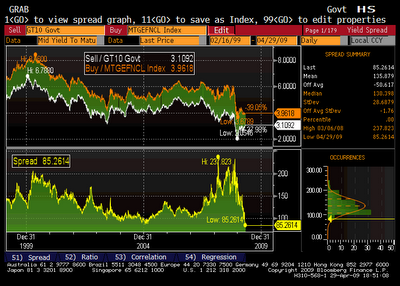
Due to the Fed's buying of Mortgage Backed Securities, this spread is now at an all time low. This is completely insane. One of the main reasons we are in this financial mess is because of a complete lack of risk evaluation during the lending process. This chart indicates that, thanks to actions by the Fed, we are now willing to lend more recklessly than ever in an attempt to keep the party going.
Look closely at the progress of the chart. As the economy was turning at the start of the dot.com collapse, the Fed (under Greenspan) flooded the market with cash. A lot of that cash obviously found its way into home mortgages as the spread narrowed quickly from a recessionary 200 bps to just above 100 bps.
Then, during the second half of 2002, the market attempted to return to a more normal state of affairs at around 150bps. However, instead of stabilizing, with the Fed apparrantly unable to get rid of the excess money in the system, the spread quickly collapsed again, bottoming out at under 100 bps in the beginning of 2005. This, of course, aligns quite neatly with the peak of the home-loan insanity, when anyone who could fog a mirror could get a mortgage for pretty much any amount they liked.
Then, as things started to implode, this spread widened out again to around 200bps. Note that if the market had truly overreacted, this spread should have shot up a lot more to compensate lenders for the increased risk of lending in a highly recessionary environment. All the market did was try to price in an appropriate amount of risk, and return to some semblance of sanity in lending standards.
But the financial oligarchy wouldn't have any of that! Instead, the Fed has crushed this spread right back down, to such an extent that, from a credit-risk perspective, we're now even worse off than we were in 2005. Anyone who thinks this could possibly end well is a complete and utter moron. Mortgaging the future, indeed.
Posted by: Hermit Dave at
07:47 PM
| No Comments
| Add Comment
Post contains 366 words, total size 2 kb.
April 28, 2009
Ever had a tooth extracted? Â These days they pack the bone with a graft in the event that you want to have an implant. Â Painful, but no problem.
Here's what bugs me ... they then pack the loose gum with some healing gel crapola that works fine ... but it shrinks, leaving the final stitches really loose. Â Then, because you're a typical OCD freak who can't leave anything alone, the loose stitches drive you nuts until you work them out with your tongue.
Er ... where was I going with this? Â Oh yeah, lotta blood and a return trip to the dentist to tighten up the stitches. Â Sometimes modern medicine is just too good for the human race.
Posted by: Hermit Dave at
10:30 PM
| No Comments
| Add Comment
Post contains 123 words, total size 1 kb.
I had at least three clear thoughts today ... which is a new high score since I quit smoking. Â Yay me!
Plus, if I can still add, or divide, or whatever the fuck mathematical operation is involved ... I'm now at 3 weeks smoke free!
Thank god for Commit Lozenges ... at 4 mini-pacs of those a day, my current NRT (nicotine replacement therapy) habit is only 2x as expensive and 3x as addictive as smoking! Â Yay?
Posted by: Hermit Dave at
09:59 PM
| No Comments
| Add Comment
Post contains 85 words, total size 1 kb.
Michelle Malkin is far more conservative than I will ever be. However, she is philosophically consistent, and is willing to base her writings on her philosophy rather than partisan politics.
She regularly calls out Republican pols when they differ from her philosophies, has been a huge Tea Party supporter, and has a very clear sense of self outside of the political arena.
Are her writings political in nature? Yes, very much so. This is not my particular baliwick, yet I appreciate her ability to compartmentalize her philosophy from her politics. First, she is a conservative ... second, she applies that philosophy to politics ... third, she combines that into her economic views.
I often disagree with her starting point (I'm far more socially liberal), yet her writings are highly consistent, so that it is easy to follow her logic. On economic fronts, I agree with her a large majority of the time. Her weakness in this area is merely one of information; however, this is also a strength. She doesn't pretend to an economic education that she does not have.
Again, Michelle Malkin is a conservative first and foremost. As I've noted before, I think this is putting the cart before the horse (and there is zero doubt she'd honestly disagree with me on this point), but given the consistency of her approach, she is always worth reading.
Posted by: Hermit Dave at
09:27 PM
| No Comments
| Add Comment
Post contains 233 words, total size 2 kb.
44 queries taking 0.0758 seconds, 127 records returned.
Powered by Minx 1.1.6c-pink.

